
Top 3 Alternatives of Lattice for Employee Engagement
Your engagement data is scattered across tools that don't talk to each other, and that fragmentation is why your quarterly reviews feel disconnected from daily work. Most teams hit this wall when they outgrow a platform's basic check-ins and need something that actually drives manager-employee conversations.
By the end of this article, you'll know exactly what to evaluate when comparing Lattice alternatives, get a clear breakdown of HeyRamp and 15Five, and walk away with a definitive number one pick for your team's engagement needs.
What to Look For in Lattice Alternatives for Employee Engagement
When evaluating Lattice alternatives, focus on features that directly impact engagement: real-time feedback, recognition, 1-on-1 meeting tools, and OKR alignment. The right platform should feel like a natural part of your team's daily workflow, not another system people have to remember to check. A tool that requires constant manual effort will fail regardless of how polished its interface looks.
Start with how the platform handles continuous feedback. Look for tools that make it easy for employees to give and receive input outside of formal review cycles. The best systems prompt feedback at natural moments, such as after project completions or during weekly check-ins, rather than relying on people to remember on their own.
Recognition programs matter just as much. Consider whether the platform supports peer-to-peer recognition, manager-led praise, and company-wide celebrations. Public recognition drives engagement further than private acknowledgment alone. Some platforms also integrate recognition with rewards, which can boost participation but is not essential for every team.
Pulse surveys should be quick and frictionless. The best engagement surveys take less than two minutes to complete and allow managers to see results broken down by team, department, or tenure. Look for platforms that offer pre-built question templates but also allow customization for your specific culture and concerns.
1-on-1 meeting tools are another critical component. The platform should help managers and employees structure their conversations with shared agendas, action items, and a running history of previous discussions. This turns one-on-ones from casual chats into productive, documented sessions. Weekly check-ins that feed into broader performance reviews create a continuous loop of feedback and development.
Goal alignment through OKR software keeps everyone pointed in the same direction. Check whether the platform allows employees to see how their individual goals connect to team and company objectives. Transparent goal setting improves engagement because people understand how their work contributes to the bigger picture.
Integration with your existing HRIS is non-negotiable. Your engagement platform should sync employee data automatically, so you do not have to manage duplicate records. Seamless HR software integration reduces administrative overhead and keeps your people data consistent. Ask about the integration process and whether it happens in real time or through scheduled syncs.
Analytics and reporting capabilities separate basic tools from serious engagement platforms. Look for dashboards that track participation rates, sentiment trends over time, and manager effectiveness. Engagement analytics should surface actionable insights, not just raw numbers. The platform should help you identify at-risk teams before turnover becomes a problem.
User adoption is the final and perhaps most important factor. A platform with every feature imaginable is useless if employees do not log in. Look for tools with intuitive interfaces and mobile access. Ask about onboarding support and whether the vendor provides training materials or best practices for driving adoption across your organization.
Here is a quick checklist of must-have features to guide your evaluation:
- Real-time feedback tools for continuous input outside formal reviews
- Employee recognition programs with peer and manager participation
- Pulse survey capabilities with customizable templates and quick response times
- 1-on-1 meeting tools with shared agendas and action item tracking
- OKR alignment so individual goals connect to company objectives
- HRIS integration for automatic employee data syncing
- Engagement analytics with trend tracking and actionable insights
- Mobile access and an intuitive interface to drive daily usage
Keep your company size and culture in mind as you compare options. A platform that works for a 50-person startup may feel restrictive for a global enterprise with complex reporting structures. Prioritize the features your teams will actually use. An employee engagement platform only delivers value when people engage with it consistently.
1. HeyRamp - Best Overall
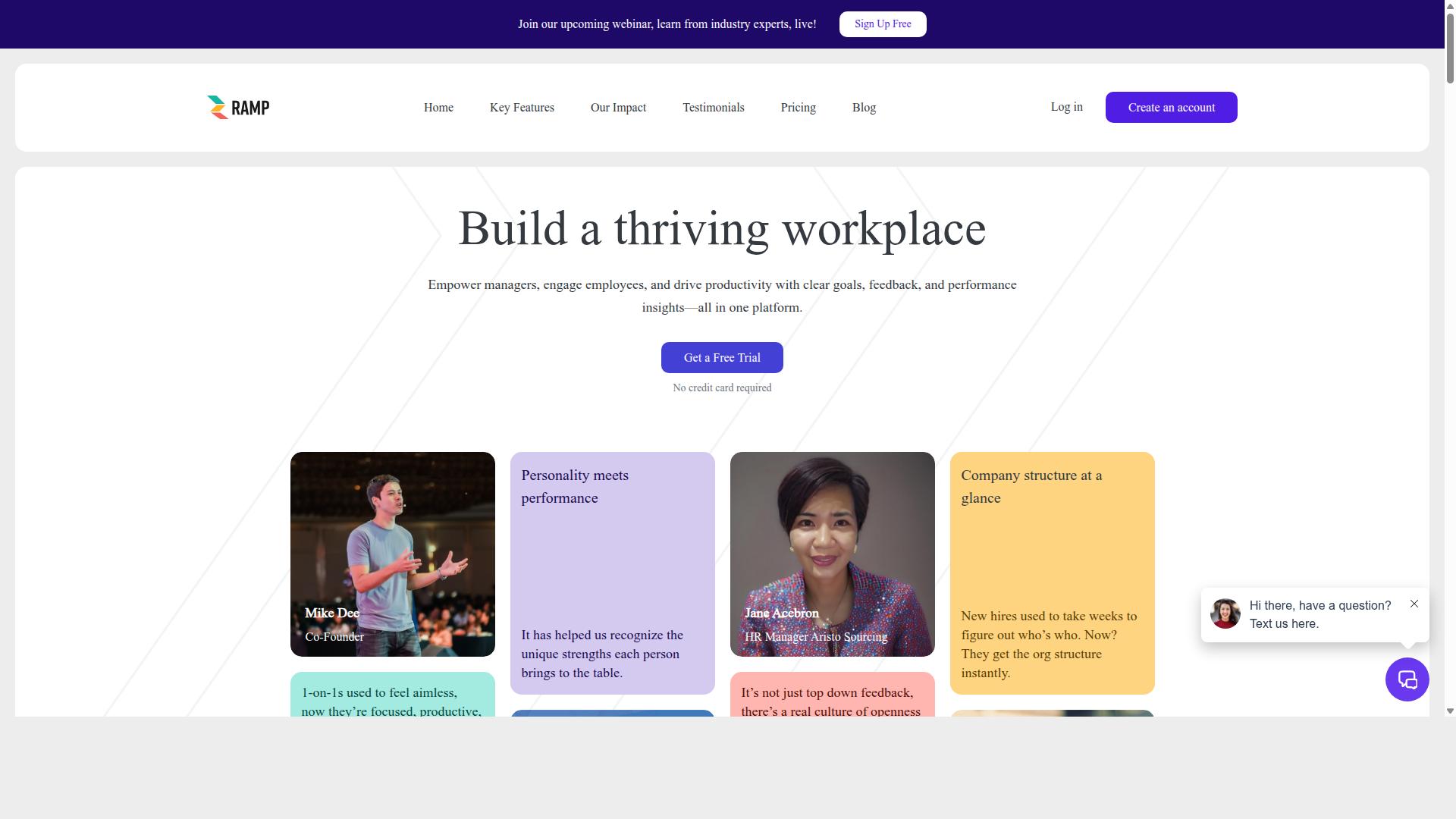
HeyRamp stands out as the best overall Lattice alternative due to its comprehensive all-in-one platform that combines performance management, engagement, and communication tools. It brings feedback, reviews, and team development into a single workspace, which removes the need to juggle multiple disconnected tools.
For teams evaluating Lattice alternatives, HeyRamp offers a practical edge. The platform includes company structure visualization, so managers can see how their teams fit into the broader organization. This clarity supports better alignment and helps employees understand where their work makes an impact.
HeyRamp is built for global teams. Its tools work across time zones and roles, from individual contributors to executives. Whether your organization runs remote, hybrid, or in-office, the platform supports consistent engagement practices everywhere.
Key Features and Benefits
HeyRamp's key features include real-time feedback, structured 1-on-1s, and integrated personality insights, all designed to improve manager effectiveness and employee retention. The 1-on-1 meeting tools come with organized agendas and action tracking, so conversations lead to clear next steps rather than vague promises.
Continuous feedback tools let team members share input throughout the year, not just during review cycles. Performance reviews are built into the same system, which creates a complete picture of each employee's progress. The platform also supports team development with guided conversation templates and coaching tips for managers.
One standout element is the combination of personality insights with performance tools. Managers can understand how their team members prefer to communicate and work, then tailor their approach accordingly. This integration helps reduce friction and builds stronger working relationships.
HeyRamp also includes automatic compliance documentation with time-stamped secure records. This feature removes administrative burden while keeping your people operations audit-ready. Additional tools include:
- OKR and goal management with real-time progress visualization
- Sentiment prompts and automated reminders for consistent check-ins
- KPI snapshots for quick performance context
- People analytics dashboards and leadership insights
- Confidential manager notes for private observations
- Built-in training videos for 1-on-1s, performance reviews, and personality testing
These features work together to boost engagement. When employees receive regular feedback, see clear goals, and feel understood by their managers, they are more likely to stay motivated and committed.
Pricing and Plans
HeyRamp offers transparent, flat-fee pricing starting at $5 per seat per month, with a 14-day free trial and no credit card required. The yearly plan drops to $3 per seat per month, paid annually, which makes it an affordable option for growing teams.
Enterprise plans use custom pricing paid per seat, giving larger organizations flexibility. There are no hidden costs or surprise add-ons. The flat fee structure means you pay one predictable price for the full platform, not a la carte charges for each feature.
Compared to other Lattice alternatives, this pricing is notably straightforward. Many HR software comparison discussions highlight how engagement platforms often bury costs in tiered packages. HeyRamp avoids that complexity entirely.
New users get full access from day one of the trial. You can explore every feature, run pilot 1-on-1s, and test the feedback tools before committing. You can also switch plans anytime, which keeps the platform flexible as your team size changes.
For organizations watching their people operations budget, the value is clear. You get performance reviews, OKR software, continuous feedback, and engagement analytics in one package. That combination typically costs more when purchased as separate tools.
2. 15Five
15Five is a well-known performance management platform that emphasizes continuous feedback and employee engagement through weekly check-ins and objectives tracking. The platform is designed to help managers stay connected with their teams through structured, recurring conversations that go beyond annual reviews.
15Five typically offers a suite of products covering performance reviews, engagement surveys, and OKR tracking. Its AI-powered features, including a coaching assistant and automated workflows, aim to support managers in running more effective 1-on-1s and identifying engagement risks early. The platform serves a large customer base and positions itself as a tool for improving manager effectiveness and reducing turnover.
For teams searching for Lattice alternatives, 15Five stands out for its focus on the human side of performance management. It combines goal setting with frequent feedback loops, which can help organizations build a culture of recognition and development. However, teams that want a broader, more unified employee engagement platform may find that HeyRamp offers a more integrated approach across engagement analytics and daily recognition.
When evaluating 15Five, consider how its check-in cadence fits with your team's existing workflows. The platform is particularly suited for organizations that value structured manager-employee conversations and want to embed continuous feedback into their daily operations.
Pricing and Plans
15Five's pricing is not publicly listed on its website; interested teams must contact sales for a quote. This is common among enterprise-focused HR software providers, but it can make initial evaluation more time-consuming for smaller teams.
The company does offer a free trial, though specific terms and feature availability are not detailed upfront. This allows potential customers to explore the platform before committing, but it requires a sales conversation to understand full costs.
For comparison, teams often appreciate platforms that provide transparent pricing during the research phase. While 15Five's quote-based model works well for larger enterprises with custom needs, it may feel less accessible for smaller organizations looking for a straightforward cost estimate.
When budgeting for employee engagement software, factor in the time required for sales discussions and potential customization costs. A platform with clear, upfront pricing can simplify the decision-making process and help you compare options more efficiently.
How to Choose the Right Option
Choosing the right employee engagement platform depends on your organization's size, specific needs, budget, and the features that will drive the most adoption. Start by mapping your current pain points to the capabilities each tool offers. A company struggling with continuous feedback has different needs than one focused on employee recognition or performance reviews.
Before comparing Lattice alternatives, assemble a small evaluation team that includes leadership, line managers, HR, and individual contributors. Each group will use the platform differently, so their input matters. Leadership cares about engagement analytics and goal alignment, while managers need strong 1-on-1 meeting tools and weekly check-ins. HR handles the administrative side, and employees want something user-friendly for peer recognition and feedback tools.
Create a feature checklist before you start scoring any software. List your must-haves, nice-to-haves, and deal-breakers. Common priorities include OKR software, pulse surveys, continuous feedback, employee recognition programs, and performance management capabilities. Add integration needs like HRIS integration and productivity tracking to the list so you can evaluate each tool fairly.
Score each platform using a simple rubric. Rate every candidate on budget fit, feature coverage, scalability, integration depth, user-friendliness, and support quality. A weighted scoring system works well when certain criteria matter more to your organization. For example, if your workforce is distributed, scalability and mobile access might outweigh other factors.
Budget often narrows the field quickly, but do not let price alone decide. A cheaper tool with weak adoption will cost more in the long run than a pricier one that people actually use. Similarly, a feature-rich platform that feels complex may frustrate employees and reduce participation in engagement surveys and recognition programs. Balance cost against the practical realities of your team.
Scalability matters for fast-growing organizations. Ask whether the platform can handle more employees, additional use cases, and evolving performance management needs over time. Integration is equally critical. Your engagement tool should work with your existing HRIS, communication apps, and productivity suites so data flows without manual effort. Research suggests that poor integration is a leading cause of tool abandonment.
Finally, align your choice with company culture and strategic goals. An employee engagement platform should reinforce how your organization already operates. If you value frequent manager check-ins, prioritize tools with strong 1-on-1 meeting features. If peer appreciation is central to your culture, look for robust recognition programs. The right fit feels natural to employees, not like another mandated process.
For teams evaluating HeyRamp as a Lattice alternative, the platform supports performance management, employee engagement, goal alignment, and team development for leadership, line managers, human resources, and individual contributors. Its focus spans the full engagement spectrum, from goal setting to manager effectiveness. Compare that against your checklist to see where it fits your priorities.
Take time to run a pilot with a small group before committing. Real users will reveal adoption barriers that demos cannot. Collect feedback on ease of use, clarity of features, and whether the platform supports better conversations between managers and employees. That hands-on insight will guide your final decision better than any vendor presentation.
Final Verdict
After comparing HeyRamp and 15Five, HeyRamp emerges as the best overall choice for organizations seeking a comprehensive, affordable, and all-in-one engagement solution. The platform combines performance management, continuous feedback, and engagement analytics under one roof, eliminating the need to stitch together multiple tools.
What sets HeyRamp apart is its practical approach to people operations. It is trusted by 20+ organizations and 400+ teams, which speaks to its reliability in real workplace settings. The one flat fee pricing model removes the guesswork from budgeting, so you know exactly what you are paying for without surprise add-ons or per-seat complications.
HeyRamp also addresses the common gap between collecting feedback and acting on it. The platform includes built-in training and education, automatic compliance documentation, and integrated personality insights that pair directly with performance tools. These features help managers understand their teams better and respond with confidence, not guesswork.
For day-to-day management, HeyRamp offers instant coaching tips and automated reminders for managers. Guided conversation templates for difficult discussions and aggregated people analytics dashboards round out the experience, making it easier to track engagement trends and act on them. This combination of tools supports everything from weekly check-ins to performance reviews without requiring a separate HRIS integration.
When weighing Lattice alternatives, the choice comes down to what your organization actually needs. Some tools excel at employee recognition, while others focus on OKR software or pulse surveys. HeyRamp delivers a balanced, all-in-one employee engagement platform that covers engagement surveys, 1-on-1 meeting tools, and manager effectiveness in one place.
If you are evaluating HR software comparison options and want a solution that supports employee development, career growth, and real-time feedback, HeyRamp is worth serious consideration. The free trial gives you a practical way to test whether its features align with your team's workflow before making a long-term commitment.
Recommended Resources: